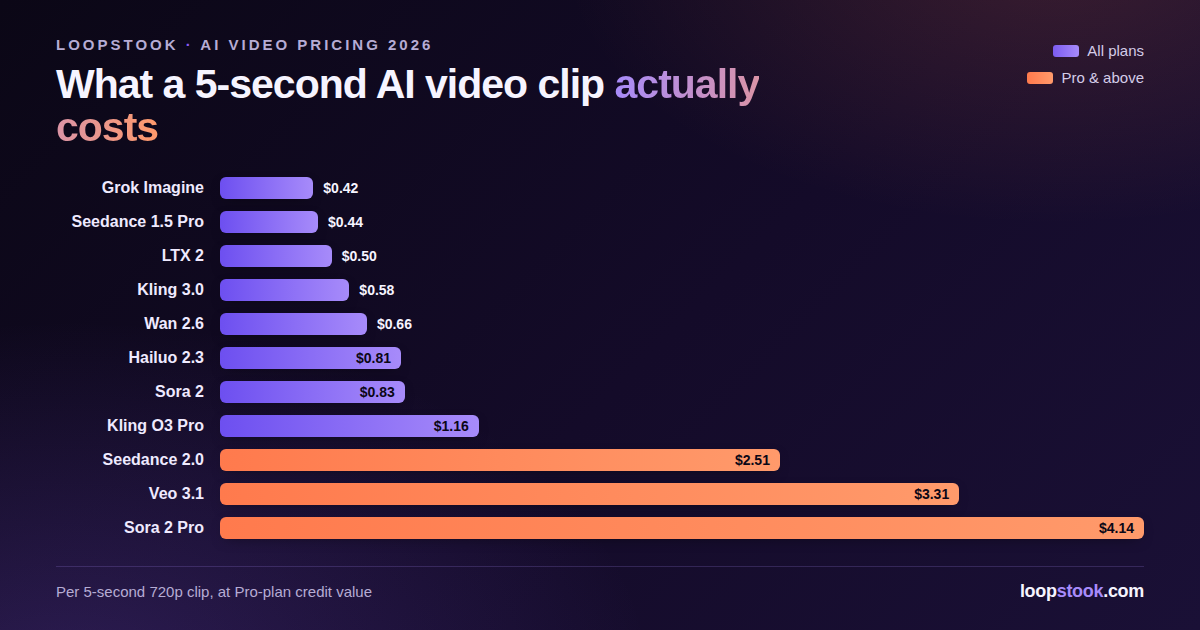
In 2026, a 5-second 720p AI video clip costs roughly $0.42 to $4.14 depending on the model. Budget models like Grok Imagine and Kling 3.0 run about $0.42–$0.58 per clip, while premium models like Veo 3.1 and Sora 2 Pro cost roughly $3.31–$4.14. Most models bill per second of output, so longer clips scale linearly.
Those numbers come from LoopStook's live launch pricing, where every model runs under one subscription and one credit balance. Below is the full per-clip table, what actually drives the cost, and what a realistic monthly ad-testing budget looks like on each plan.
What Does a 5-Second AI Video Clip Cost, Model by Model?
Across the 11 major video models available on LoopStook, a 5-second 720p clip ranges from roughly $0.42 (Grok Imagine) to roughly $4.14 (Sora 2 Pro) at Pro-plan credit value. Three premium models — Seedance 2.0, Veo 3.1, and Sora 2 Pro — require the Pro plan or above.
| Model |
≈ Cost per 5s 720p clip |
Plan availability |
| Grok Imagine |
≈$0.42 |
All plans |
| Seedance 1.5 Pro |
≈$0.44 |
All plans |
| LTX 2 |
≈$0.50 |
All plans |
| Kling 3.0 |
≈$0.58 |
All plans |
| Wan 2.6 |
≈$0.66 |
All plans |
| Hailuo 2.3 |
≈$0.81 (flat per clip) |
All plans |
| Sora 2 |
≈$0.83 |
All plans |
| Kling O3 Pro |
≈$1.16 |
All plans |
| Seedance 2.0 |
≈$2.51 |
Pro and above |
| Veo 3.1 |
≈$3.31 |
Pro and above |
| Sora 2 Pro |
≈$4.14 |
Pro and above |
Two things jump out. First, the spread is nearly 10× between the cheapest and priciest models — which is why model choice matters more than plan choice for your effective cost per ad. Second, Sora 2 sits under a dollar per clip despite being one of the most capable models on the list, which changes the math on when "premium" is actually worth it.
What Actually Drives AI Video Generation Cost?
Three factors drive AI video pricing in 2026: duration, resolution, and audio. Most models bill per second of generated output, so a 10-second clip costs about twice a 5-second one. Higher resolutions (1080p and up) cost more per second, and models that generate native synchronized audio charge a premium for it.
- Per-second billing. The table above quotes 5-second clips because that's the standard unit for a hook or a single shot. Budget accordingly: a 15-second ad assembled from three generated shots costs roughly three clips, not one.
- Resolution. 720p is the sweet spot for social ad testing — it's cheaper and platforms compress everything anyway. Reserve 1080p+ renders for winning creatives you're scaling.
- Native audio. Veo 3.1 generates synchronized dialogue, ambient sound, and effects in the same pass. That capability is a big part of why it costs roughly $3.31 per clip versus $0.58 for Kling 3.0, which outputs silent video you score in post.
- Flat-rate exceptions. Hailuo 2.3 charges a flat rate of roughly $0.81 per clip regardless, which makes it predictable for batch jobs.
When Are Budget Models Good Enough — and When Do You Need Premium?
Budget models ($0.42–$0.83 per clip) are good enough for hook testing, b-roll, motion graphics, and most social ads. Premium models ($2.51–$4.14 per clip) earn their price when you need native dialogue, tight prompt adherence for complex scenes, or hero-level fidelity on a proven concept.
The practical workflow most performance marketers land on: test wide on cheap models, then re-render winners on expensive ones. Grok Imagine at roughly $0.42 per clip lets you throw twenty hook variations at a concept for under $9. Kling 3.0 at roughly $0.58 delivers the strongest motion quality in the budget tier and handles image-to-video from product photos well, which makes it the default for ecommerce shots.
Premium models solve specific problems. Veo 3.1's synchronized audio means a talking scene arrives finished — no voice-over pass, no lip-sync cleanup. Seedance 2.0 and Sora 2 Pro buy you fidelity and control that matter for brand-level hero assets. If your clip doesn't need those specific capabilities, the extra $2–3.50 per generation is pure margin loss.
What Does a Realistic Monthly Ad-Testing Budget Look Like?
On LoopStook, Starter is $14/month for 10,000 credits, Pro is $29/month for 25,000 credits, and Ultra is $56/month for 50,000 credits. At Pro-plan credit value, Pro covers roughly 50 Kling 3.0 clips or 34 Sora 2 clips per month — enough for a serious weekly testing cadence.
Here's the conservative arithmetic. The per-clip prices above are quoted at Pro-plan credit value ($29 for 25,000 credits). So:
- Pro ($29, 25,000 credits): roughly $29 ÷ $0.58 ≈ 50 Kling 3.0 clips, or $29 ÷ $0.83 ≈ 34 Sora 2 clips.
- Starter ($14, 10,000 credits): 40% of Pro's credits — roughly 20 Kling 3.0 clips or 13 Sora 2 clips.
- Ultra ($56, 50,000 credits): double Pro — roughly 100 Kling 3.0 clips or about 69 Sora 2 clips.
For context: a disciplined ecommerce ad-testing program might launch 10–15 new video variations a week. On Pro, that's comfortably covered with budget models, with credits left for image generation and a few premium renders. Ultra makes sense once you're testing across multiple products or clients. Full plan details are on the pricing page, and signup comes with free trial credits — no card required — so you can benchmark models before paying anything.
Is One Subscription Cheaper Than Subscribing to Each Model Separately?
For anyone using more than one or two models, yes — a single multi-model subscription is meaningfully cheaper than stacking individual subscriptions. Each frontier lab sells its model behind its own monthly plan, and those plans overlap heavily: you pay repeatedly for baseline access you only partially use.
The deeper cost isn't just the stacked monthly fees. It's the unused capacity: every separate subscription comes with its own quota, and you can't shift unspent capacity from the model you didn't use this month to the one you did. A shared credit pool eliminates that waste — the same balance flows to whichever model the job needs. It also removes the switching friction that quietly shapes creative decisions. When Sora 2 lives in one app and Kling in another, teams default to whatever they already pay for, not what's best for the shot. On a unified suite, testing Sora 2 against Kling 3.0 on the same brief costs one extra generation, not one extra subscription.
Run the Numbers Yourself
The cheapest way to learn which model fits your creative is to generate the same brief on two or three and compare — something a shared credit pool makes trivial. Start free at loopstook.com (trial credits included, no card required) and check the pricing page to see what each plan covers.