AI UGC ads are user-generated-content-style ads produced with AI instead of — or before — hiring human creators: scripted hooks, AI avatars or voice-over, generated b-roll, and auto-captions, assembled to feel like a real person's recommendation. Brands use them to test hooks, angles, and objections fast and cheap, then scale what wins.
The category matured fast. What started as janky avatar demos is now a standard part of the paid-social stack, complete with its own workflow, quality bar, and — as of June 2026 — disclosure law. This guide covers all of it.
What Are AI UGC Ads?
AI UGC ads are paid-social creatives built to look and sound like organic creator content — selfie-style delivery, casual language, native pacing — but produced partly or entirely with AI tools. The "UGC" is an aesthetic, not a sourcing method: nobody mailed a product to an influencer.
A typical AI UGC ad combines four AI-produced layers. A script written or refined by AI. A presenter layer — an AI avatar, or no face at all with voice-over carrying the ad. A visual layer of generated b-roll and product shots. And a caption layer timed to the audio.
The best ones are indistinguishable from mid-tier human creator content, which is exactly the point: UGC-style ads work because they read as a recommendation, not a commercial. AI just removed the three-week turnaround between "idea" and "live ad."
Why Do Brands Use AI UGC Ads?
Because creative testing is the highest-leverage activity in paid social, and AI UGC collapses its cost and cycle time. Instead of briefing three creators and waiting weeks for one usable variation each, a media buyer can test ten hooks, five angles, and every major customer objection in days.
The strategic pattern most teams land on: use AI UGC as the research layer. You don't know which hook, angle, or objection-handler will win — so you find out cheaply with AI variants before committing real budget to creator partnerships or premium production. When a script proves itself, you can hand the winning brief to a human creator with evidence instead of guesses.
Speed compounds too. Trends on TikTok have a shelf life of days. An AI UGC pipeline lets you react while the trend is still alive, then retire the creative without burning a production budget on a two-week fad.
What Does the AI UGC Workflow Look Like?
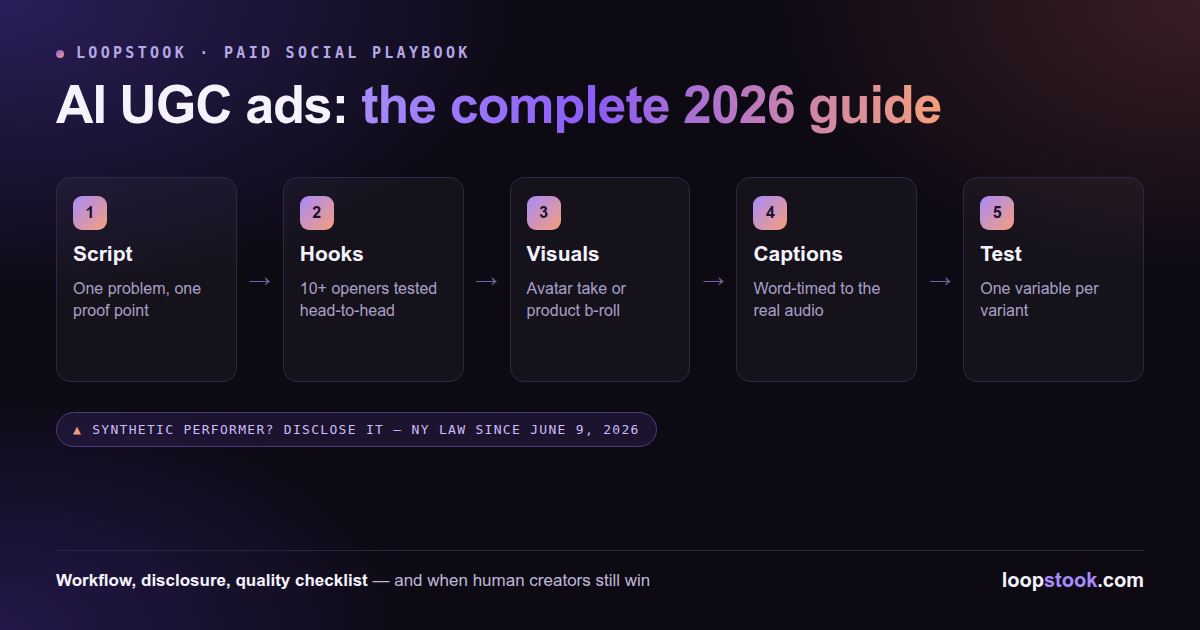
Five stages: script, hook variations, visuals, captions, test. Each stage has a tool, each tool has a job, and the whole loop runs in an afternoon once you've done it twice. Here's the standard pipeline:
| Stage |
What happens |
Tool |
| 1. Script |
Draft a 30-second UGC script around one problem and one proof point |
Free UGC script generator |
| 2. Hooks |
Spin 10+ opening-line variations to test against each other |
Free ad hook generator |
| 3. Avatar / b-roll |
Generate the presenter take and supporting product b-roll |
AI video models (avatar or product-first) |
| 4. Captions |
Add word-timed captions that match the audio exactly |
Free AI caption generator |
| 5. Test |
Launch low-budget ad sets, one variable at a time |
Meta / TikTok Ads Manager |
Two workflow rules worth tattooing somewhere. First, change one variable per variant — same script with different hooks, or same hook with different b-roll — or you'll never know what actually won. Second, keep a swipe file of every winner; your next script starts from your last winner, not from zero.
For a concrete category walkthrough — scripts, shot lists, and angle ideas for a serum brand — see AI UGC for skincare.
Do AI UGC Ads Need to Be Disclosed?
If they use a synthetic performer and can be viewed in New York — yes. New York's synthetic performer disclosure law took effect June 9, 2026: ads using AI-generated actors or performers must disclose it, with fines for violations. Since mainstream ad platforms serve New York impressions by default, treat it as a national requirement.
The practical playbook: audit running creative for synthetic presenters, add a clear on-screen disclosure to anything flagged, and make "synthetic performer: yes/no" a required field in every creative brief. Ad platforms also maintain their own AI-content policies, and those evolve — so check the current platform rules alongside the law. (This is not legal advice; confirm specifics with an attorney.) Our NY AI actor disclosure law breakdown covers the details.
The good news: disclosure doesn't kill performance for ads built on real proof. And product-first AI UGC — b-roll, demos, and voice-over with no synthetic human on screen — largely sidesteps the performer question entirely.
When Do Human Creators Still Win?
In trust-heavy categories and trust-heavy moments. Anywhere the buyer's core question is "did this work for a real person like me?" — supplements, medical-adjacent skincare, parenting products, personal finance — a verifiable human with a face, a name, and a taggable profile carries weight no avatar can.
Human creators also win when the content requires a real body doing real things: applying product to visibly changing skin, fitting clothes on a real frame, taste reactions. Viewers are getting sharp at spotting synthetic interactions, and faked physical proof reads worse than no proof.
The mature stack isn't AI versus creators — it's AI for breadth, creators for depth. Test twenty angles with AI, then pay one great creator to shoot the two angles that proved themselves — briefed with evidence instead of guesses.
How Do You Avoid the "Obviously AI" Look?
Ruthless subtraction. Most AI UGC fails from doing too much: perfect lighting, perfect skin, perfect delivery — a combination that never occurs in actual UGC. Aim your creative at "good phone footage," not "beautiful footage," and check every asset against this list:
- One idea per script. Real creators ramble around a single point; ads that cram three benefits in read as scripted.
- Hook inside two seconds. Cold-open on the problem or the product in-hand — no logos, no intro.
- Imperfect on purpose. Handheld framing, natural pauses, an "um" left in the script.
- Mix real footage in. Even two seconds of genuine product footage anchors the generated b-roll.
- Watch the hands and close-ups. Object handling and extreme facial close-ups are where synthetic video still slips; cut to b-roll instead.
- Captions must match audio exactly. Mismatched captions are the fastest "this is AI slop" tell — generate them from the actual audio.
- Sound design. Room tone and ambient noise under the voice; dead-silent backgrounds feel synthetic.
- Disclose synthetic performers. Legally required in ads viewable in New York, and increasingly a trust play everywhere else.
Build Your First AI UGC Ad Today
Start with the free tools: draft a script with the UGC script generator, spin ten openers with the ad hook generator, then generate, caption, and launch — all inside one subscription. Start free at loopstook.com — no card required.