New York's AI actor disclosure law took effect June 9, 2026. It requires ads that use AI-generated actors or performers to clearly disclose that fact, and violations carry fines. If your ads feature synthetic humans and can be viewed in New York, you need a disclosure — and a repeatable process for auditing creative before it ships.
The timing matters. Brands are shipping avatar-led AI UGC ads at scale, and nearly every media buy — Meta, TikTok, YouTube, programmatic — serves impressions in New York by default. That makes this a national compliance question, not a state-level footnote.
This article is not legal advice. It's a practical overview for marketers. Talk to a qualified attorney before making compliance decisions for your business.
What Does the AI Actor Disclosure Law Require?
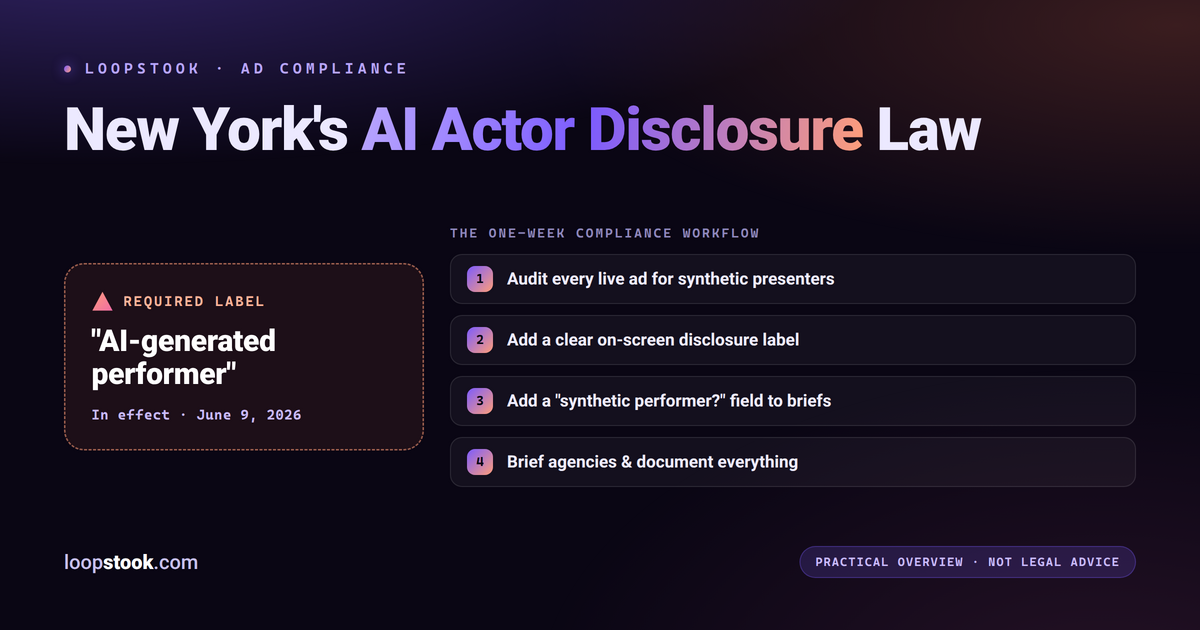
In plain language: if an ad uses an AI-generated actor or performer — a synthetic human who appears to deliver the ad the way a real person would — the ad must clearly disclose that the performer is AI-generated. The law has been in force since June 9, 2026, and violations can draw fines.
The creative formats most obviously in scope are the ones built to feel human: AI avatar presenters doing testimonial-style delivery, digital spokespeople, and synthetic "creators" filmed selfie-style. The common thread is a viewer who could reasonably believe a real person is performing in the ad.
Creative that doesn't put a synthetic human on screen — product footage, b-roll, motion graphics, text-and-voiceover edits — is a different situation, though edge cases exist. When in doubt about a specific format, ask counsel rather than guessing.
Who Does the Law Apply To?
Practically, any brand running ads that can be viewed in New York — which is almost every brand advertising on Meta, TikTok, YouTube, or the open web. Unless you geo-exclude New York from every campaign and can prove it held, the safest operating assumption is that the law applies to you.
That assumption is worth making even if you could theoretically geo-fence. Platform geo-targeting is built for media efficiency, not legal guarantees: audiences travel, placements leak, and boosted organic posts often ignore campaign-level exclusions. One escaped impression is all it takes.
It also applies up and down the supply chain in practice. Brands, in-house teams, agencies, and freelancers all touch creative that could trigger the requirement, so everyone who briefs, builds, or launches ads needs to know the rule.
How Do You Make Your Ad Creative Compliant?
Treat this like any other creative-ops requirement: audit what's live, label what needs labeling, and change your intake process so nothing un-reviewed ships again. Here's the workflow most teams can implement in a week:
| Step |
What to do |
Who owns it |
| Audit live creative |
Inventory every running ad; flag anything with a synthetic human presenter |
Creative ops / media buyer |
| Add disclosures |
Put a clear, visible label (e.g., "AI-generated performer") on flagged ads — on-screen, not buried in a caption |
Creative team |
| Update briefs |
Add a required field to every brief: "Synthetic performer: yes/no. Disclosure plan:" |
Marketing lead |
| Brief agencies |
Put disclosure requirements into contracts, SOWs, and creative guidelines |
Legal + marketing |
| Document everything |
Keep a record of which ads used AI performers and what disclosure ran |
Compliance |
Have your attorney sign off on the exact disclosure wording and placement standard once, then apply it as a template. The goal is a system where compliance is a checkbox in the workflow, not a scramble before each launch.
No — at least not for ads that were working for the right reasons. If a creative only converts because viewers believe a synthetic person is real, it was borrowing trust it hadn't earned. Authenticity-first creative — a strong offer, a real demonstration, honest proof — keeps performing with the label on.
Some teams are even leaning into it: "Yes, this presenter is AI. The results are real." Treated as a creative element instead of fine print, the disclosure becomes a pattern interrupt rather than a penalty. Test placements and phrasings the way you'd test any other on-screen element.
The deeper fix is writing scripts that don't depend on faked intimacy. A free tool like the UGC script generator builds scripts around problem, mechanism, and proof — the parts of an ad that still work when everyone knows how it was made.
How Do You Avoid the Issue Entirely?
Make AI video without synthetic humans. Product-first creative — b-roll, macro texture shots, demos, unboxing hands-free sequences, motion graphics with voice-over — puts no AI-generated performer on screen, so a synthetic performer disclosure law has nothing to attach to. In many DTC categories it also outperforms talking heads.
This is where current video models shine. Veo 3.1 generates cinematic product b-roll with native synchronized audio and strong prompt adherence, which means you can build an entire ad from product shots, ambient sound, and captions. For a category example, see how skincare brands structure product-led creative in AI UGC for skincare — serum textures, application close-ups, and results-framing that never require a synthetic face.
One caution: if you add synthetic voice-over, ask counsel whether a cloned or AI voice counts as a "performer" in your specific use. Don't assume audio is automatically exempt.
Ship Compliant Creative Faster
The simplest way to stay ahead of the AI actor disclosure law is creative that never needs the label: product-first video generated with models like Veo 3.1, scripted for proof instead of pretend testimonials. LoopStook puts 13 AI video models, image, audio, and free script tools under one subscription. Start free at loopstook.com — no card required.