GPT Image 2 is the better pick for precise instruction-following, in-image text rendering, and cheap volume work at roughly $0.07 per image on LoopStook. Nano Banana Pro, at roughly $0.25 per image, wins for photorealistic subject-consistent edits and identity preservation — it's the engine behind the viral selfie-edit trends.
For a marketing team, that means the two models split the workload rather than compete for it. Here's the feature-by-feature comparison, then verdicts for the four jobs marketers actually hire an image model for.
What's the Real Difference Between GPT Image 2 and Nano Banana Pro?
The core difference: GPT Image 2 excels at following complicated instructions — layouts, labels, readable text inside the image — while Nano Banana Pro excels at editing a real photo without breaking the subject. One is a precision compositor; the other is a photorealistic identity-preserving editor.
Ask GPT Image 2 for "a three-panel comparison graphic with the headline 'Ships in 24 Hours' in bold sans-serif" and it renders the panels and the words, legibly. That combination of instruction-following and text rendering used to be the wall every image model hit.
Nano Banana Pro — from Google's Gemini image model family — attacks a different problem: take this photo of a person or product, change the scene, outfit, or style, and keep the subject recognizably the same. That identity preservation is why the Nano Banana family powers the viral figurine and saree selfie-edit trends: people feed in their own photo and get themselves back, transformed but unmistakably them.
How Do They Compare Feature by Feature?
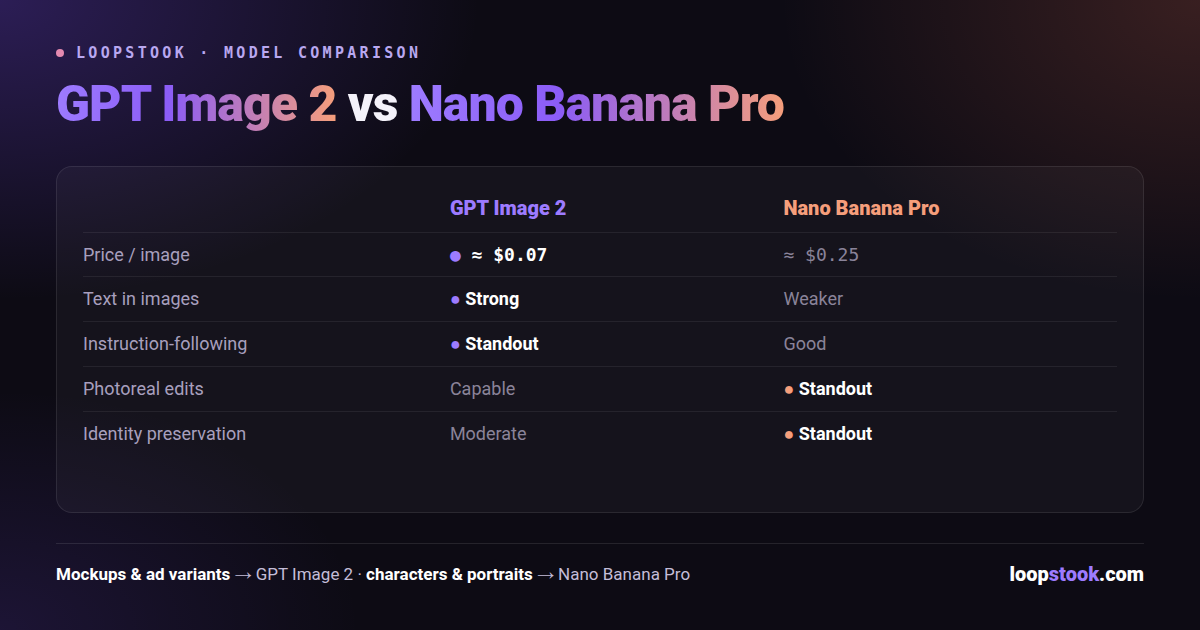
At a glance: GPT Image 2 costs roughly a quarter as much per image and leads on instructions and text; Nano Banana Pro leads on photorealism and subject consistency across edits. Both run under the same LoopStook subscription and shared credit balance.
|
GPT Image 2 |
Nano Banana Pro |
| Price on LoopStook |
≈$0.07 per image |
≈$0.25 per image |
| Instruction-following |
Standout — handles complex, multi-part prompts |
Good |
| Text rendering in images |
Strong — legible headlines, labels, packaging copy |
Weaker fit for text-heavy layouts |
| Photorealistic edits |
Capable |
Standout — edits look like photographs |
| Identity / subject preservation |
Moderate |
Standout — same face, same product, across edits |
| Signature use |
Ad variants, mockups, text-in-image graphics at volume |
Selfie-trend edits, brand characters, portrait work |
The side-by-side with example outputs is on the Nano Banana vs GPT Image comparison page.
When Is GPT Image 2 the Right Choice?
Choose GPT Image 2 for anything text-bearing, layout-driven, or high-volume. At roughly $0.07 per image, generating fifty ad variants costs about $3.50 — cheap enough to treat static creative testing the way you treat copy testing: produce many, kill most.
It earns the volume role in three ways. First, text rendering: promo banners, packaging mockups, app-store screenshots, and quote cards all need words inside the image, and GPT Image 2 renders them cleanly instead of producing alphabet soup. Second, instruction-following: multi-element prompts — "product left, benefit list right, logo top-right corner" — come back composed as specified, which means fewer retries and less manual cleanup. Third, the price makes iteration psychologically free; nobody hesitates to regenerate a $0.07 image five times to nail the layout.
When Is Nano Banana Pro Worth $0.25 Per Image?
Nano Banana Pro is worth the premium whenever the subject must stay the same across images — a founder's face, a brand mascot, a hero product. Identity preservation is the hardest problem in image editing, and paying roughly three to four times more per image is trivial next to a reshoot.
This is the model for photorealistic scene swaps: put the same handbag on a marble countertop, a beach towel, and a studio sweep, and it reads as the same bag photographed three times. It's the same capability that made the figurine and saree selfie edits go viral — people recognize themselves in the output, which is precisely the bar marketing portraiture has to clear. For personal branding, that means one decent headshot becomes a consistent set: conference-stage shot, casual office shot, editorial portrait, all recognizably the same person.
For product categories where surface detail sells — see jewelry product photography — Nano Banana Pro's photorealism keeps stones, metal, and reflections believable through the edit instead of smoothing them into plastic.
Which Model for Which Marketing Job?
Quick verdicts: GPT Image 2 for product mockups and ad variants; Nano Banana Pro for brand characters and personal branding portraits. When a job needs both precision layout and subject consistency, generate the composition in one and refine the subject in the other.
- Product mockups → GPT Image 2. Labels, packaging text, and precise placement instructions are its home turf, at a price that invites iteration.
- Ad variants at volume → GPT Image 2. Fifty static variants for roughly $3.50 makes broad creative testing a rounding error in the ad budget.
- Brand characters → Nano Banana Pro. A mascot or recurring character must look identical across every asset; identity preservation is the feature you're buying.
- Personal branding portraits → Nano Banana Pro. Photoreal, recognizably-you outputs across settings and styles — the selfie-trend engine put to commercial use.
Try Both on One Brief
Run the same product photo through both models — a text-heavy promo layout in GPT Image 2, a photoreal scene swap in Nano Banana Pro — and you'll know within ten minutes which jobs belong to which. Start free at loopstook.com; trial credits are included, no card required.