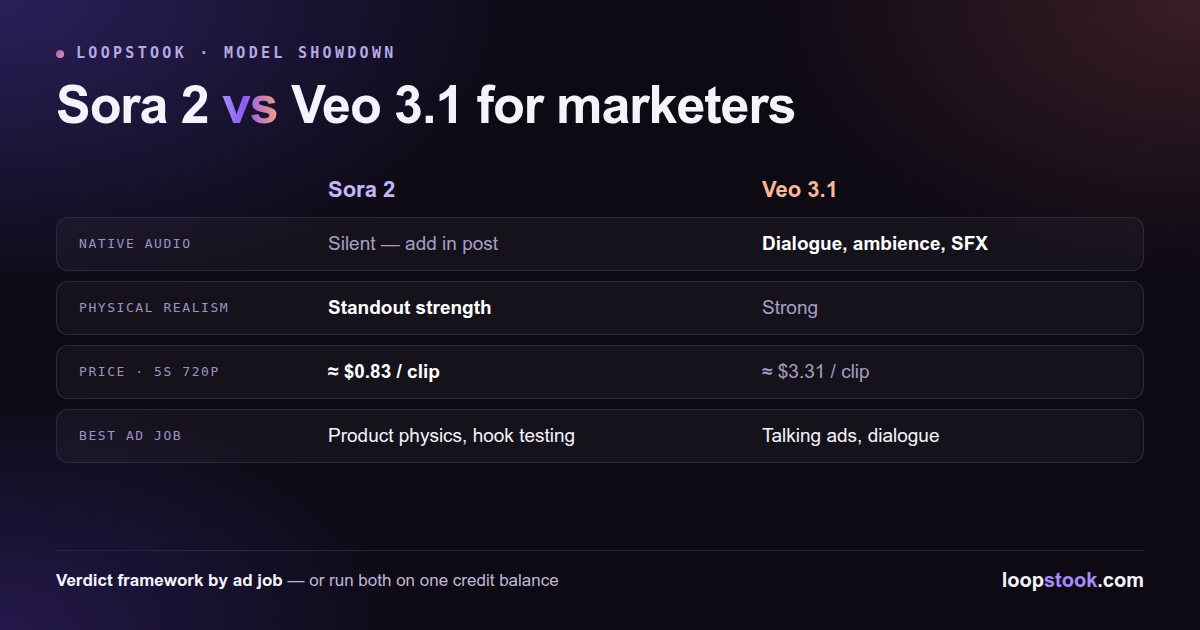
Veo 3.1 wins when you need native synchronized audio and tight prompt adherence — dialogue scenes and talking ads arrive finished. Sora 2 wins on physical realism and price: roughly $0.83 per 5-second clip on LoopStook versus roughly $3.31 for Veo 3.1, which also requires a Pro plan or above.
That's the short version. The longer version depends on what kind of ad you're making, how much volume you're testing at, and whether you're willing to add sound in post. Here's the head-to-head, then a verdict framework by ad job.
How Do Sora 2 and Veo 3.1 Compare Head to Head?
Sora 2 and Veo 3.1 aren't interchangeable — they're specialists. Veo 3.1's headline capability is native synchronized audio plus strong prompt adherence. Sora 2's is physical realism: objects, materials, and motion behave believably. On LoopStook they differ 4× in price and sit on different plan tiers.
|
Sora 2 |
Veo 3.1 |
| Native synchronized audio |
No — silent output, add sound in post |
Yes — dialogue, ambience, SFX in one pass |
| Physical realism |
Standout strength — believable physics and materials |
Strong, but not its headline trait |
| Prompt adherence |
Good |
Strong — follows complex scene directions closely |
| Price on LoopStook (5s, 720p) |
≈$0.83 per clip |
≈$3.31 per clip |
| Plan availability |
Any plan |
Pro and above |
| Best use cases |
Product physics, realistic motion, budget-friendly volume testing |
Talking ads, dialogue scenes, finished-audio spots |
The full breakdown lives on the Sora 2 vs Veo 3 comparison page, but the table above covers the decisions that matter for ad work.
When Should You Pick Veo 3.1?
Pick Veo 3.1 whenever the ad needs someone to speak, or when sound is doing real work in the creative. Because Veo 3.1 generates synchronized dialogue, ambient noise, and effects natively, a talking scene comes out of the model ready to trim and ship — no voice-over recording, no lip-sync repair, no foley pass.
That collapses the most expensive part of the traditional workflow. A spokesperson-style ad or a two-line dialogue scene that used to require voice casting and audio editing becomes a single prompt. Veo 3.1's strong prompt adherence compounds this: when your script specifies "she holds up the bottle, says the line, then smiles at the camera," it tends to deliver those beats in order, which matters enormously when the audio and the action have to sync.
One compliance note for talking ads: New York's synthetic performer disclosure law took effect June 9, 2026 — AI actors in ads must be disclosed, with fines for violations. Whichever model generates your on-camera "person," build the disclosure into your creative process now. Our NY AI actor disclosure law guide covers the specifics.
The trade-off is cost and access. At roughly $3.31 per 5-second clip, Veo 3.1 is a finishing tool, not a brainstorming tool — and it's available on Pro plans and above, per the pricing page. Need prompts? Start with our 50 Veo 3.1 prompts for product ads.
When Should You Pick Sora 2?
Pick Sora 2 when the believability of the footage itself is the selling point — and whenever you're testing at volume. Sora 2's physical realism means liquids pour, fabric drapes, and products move the way a viewer's eye expects, which is exactly what makes ecommerce footage feel like footage rather than CGI.
For product-centric ads, this is often the whole game. A skincare serum dropping onto skin, a phone case hitting pavement, steam rising off a coffee — these shots live or die on physics, and Sora 2 is the strongest realism-per-dollar option on the board. Our 30 Sora 2 prompts for ecommerce are built around exactly these shots.
Then there's the price. At roughly $0.83 per 5-second clip on any LoopStook plan, Sora 2 costs about a quarter of Veo 3.1. That changes behavior: you can generate ten Sora 2 variations of a hook for roughly the price of two and a half Veo 3.1 clips. For top-of-funnel testing, where most creatives fail anyway, paying premium prices for losers is the fastest way to burn a budget. Sora 2's silent output isn't a real limitation there either — feed-first ads are routinely built for sound-off viewing, and adding a music bed or voice-over in post is cheap.
Which Model Wins for Which Ad Job?
Match the model to the job: Veo 3.1 for talking ads and dialogue scenes, Sora 2 for product physics and budget hook testing. Neither model wins outright — the wrong choice either overpays for silence or underpays for realism you didn't need.
- Talking ads and spokesperson spots → Veo 3.1. Native lip-synced dialogue is the entire reason to pay the premium. Nothing in the budget tier replaces it.
- Product physics and demo shots → Sora 2. When the shot has to look real — pours, drops, bounces, textures — Sora 2's realism advantage shows up on screen.
- Dialogue scenes with multiple beats → Veo 3.1. Strong prompt adherence plus synchronized audio makes multi-action scripted scenes far more reliable.
- Budget hook testing at volume → Sora 2. At ≈$0.83 per clip, you can test four hooks on Sora 2 for the price of one Veo 3.1 render, then re-render the winner wherever it belongs.
Why Not Run Both and A/B Test?
Because both models live under one LoopStook subscription and one credit balance, the honest answer to "Sora 2 vs Veo 3.1" is often "both, on the same brief." Generate the concept on each, put both variants into a small paid test, and let the click-through data pick the winner.
This is the structural advantage of a multi-model suite: the comparison costs one extra generation instead of one extra subscription. A common pattern is to prototype and test on Sora 2, then take the winning concept to Veo 3.1 when the final cut needs spoken lines — you spend premium credits only on proven creative.
Test Both on Your Next Brief
The fastest way to settle Sora 2 vs Veo 3.1 for your brand is to run one real brief through both and compare outputs side by side. Start free at loopstook.com — trial credits are included with no card required — and see the full head-to-head on the comparison page.