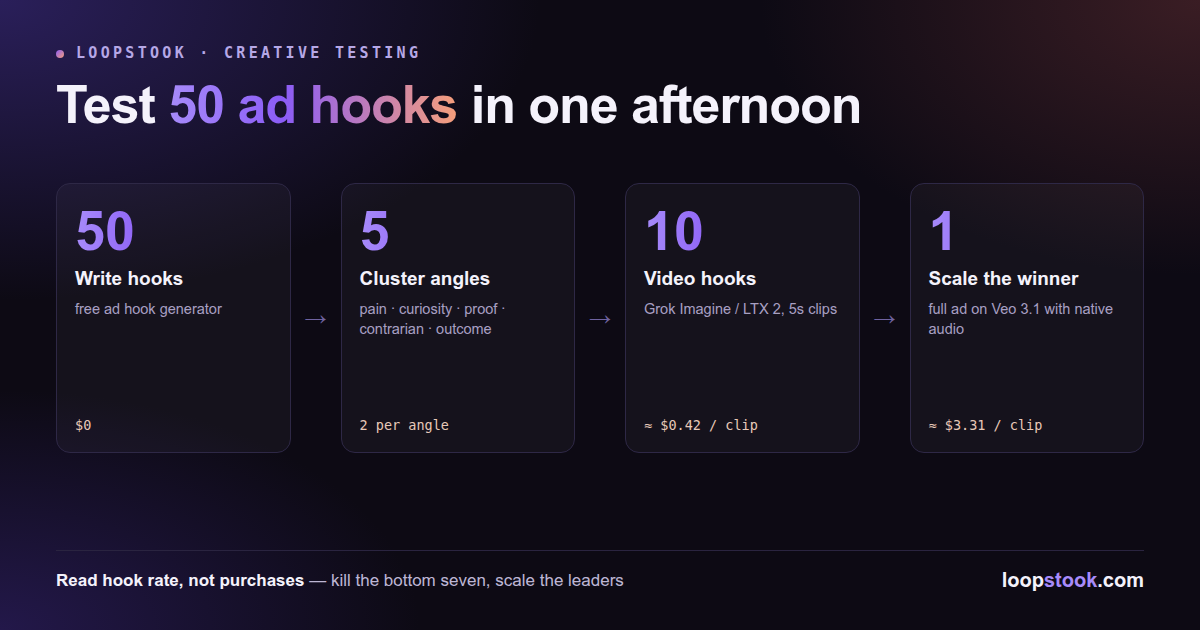
Ad hook testing with AI works like this: generate 50 hook variations with a free ad hook generator, cluster them into five angles, turn the top ten into 5-second AI video hooks for under a dollar each, launch them as low-budget tests, and rebuild the winners with a premium model like Veo 3.1.
The whole loop — 50 written hooks to 10 live video tests — fits in one afternoon and costs about as much as a coffee. Here's the playbook, step by step.
Why Does Hook Testing Come Before Everything Else?
Because the hook decides whether anyone experiences the rest of your ad. The first seconds determine whether a viewer stops scrolling; if they don't, your offer, proof, and CTA never existed. Testing hooks first means you optimize the highest-leverage variable before spending anything on full-length production.
Most teams get this backwards. They produce three polished 30-second ads, launch them, and learn almost nothing — because each ad differs in hook, body, footage, and CTA simultaneously. Hook-first testing isolates one variable, gets you a clean read, and tells you which opening earns the full production treatment.
Step 1: How Do You Generate 50 Hook Variations Fast?
Use the free ad hook generator. Feed it three inputs — what the product is, who it's for, and the top objections buyers raise — and generate in batches until you have 50 written hooks. Volume is the point: your intuition can't predict winners, but it can recognize them in a list.
Don't self-censor during generation. Awkward hooks are free to delete, and the "too weird" pile reliably contains a couple of best performers. While you're there, run the AI ad copy generator on the same inputs so body copy is ready the moment a hook wins.
Step 2: How Do You Cluster Hooks by Angle?
Sort all 50 hooks into five buckets — pain, curiosity, social proof, contrarian, and outcome — then pick your two strongest from each bucket. That gives you a top ten that covers five distinct psychological approaches instead of ten flavors of the same idea.
This clustering step is what makes the test informative. If all ten finalists are pain hooks and they all flop, you've learned nothing about the other four angles. Here's the framework with skincare examples:
| Angle |
What it does |
Example hook (serum brand) |
| Pain |
Names the problem in the buyer's own words |
"Your moisturizer isn't failing you. Your skin barrier is." |
| Curiosity |
Opens a loop the viewer needs closed |
"Estheticians keep gatekeeping this one ingredient." |
| Social proof |
Borrows trust from a crowd or authority |
"Three separate group chats asked me about this serum this week." |
| Contrarian |
Attacks advice the viewer believes |
"Stop exfoliating every day. Seriously, stop." |
| Outcome |
Shows the end state, skips the journey |
"Day 30 of swapping retinol for retinal. Look at this." |
When you pick your two per angle, favor hooks that are concrete and visual — they're about to become five-second videos, and "look at this texture" is filmable in a way "quality you can trust" is not.
Step 3: How Do You Turn the Top 10 Into Video Hooks Cheaply?
With budget video models. On LoopStook's launch pricing, a 5-second 720p clip costs about $0.42 on Grok Imagine or about $0.50 on LTX 2 — so all ten video hooks cost roughly $4–5 total. At that price, testing is cheaper than debating.
Keep the brief identical across all ten clips except for the hook itself: same product, same setting, same style. A prompt skeleton like this keeps the variable isolated:
Handheld phone-style video, soft natural window light. A dropper bottle of face serum on a bathroom counter, hand reaching in to pick it up. On-screen text overlay: "[HOOK LINE]". Casual, real, slightly imperfect framing. 5 seconds, vertical 9:16.
Swap only the [HOOK LINE] per clip. Generate, add your hook as text overlay or opening voice-over, and you have ten scroll-stopping tests ready to upload.
Step 4: How Do You Read the Early Signals?
Launch all ten as low-budget ad sets and watch attention metrics, not purchases. At small test budgets, conversion data is too thin to trust — but hook rate (3-second views over impressions) and early hold (viewers still present midway through the clip) tell you which openings actually stop the scroll.
Read them qualitatively and comparatively: rank your ten hooks against each other and against your own account's historical averages, not against internet benchmark numbers, which vary wildly by niche and placement. Comments are a bonus signal — a hook that provokes questions or arguments is doing its job. Kill the bottom seven without sentiment; two or three clear leaders is a great afternoon.
Step 5: When Do You Scale Winners With Premium Models?
Once a hook has clearly beaten its siblings, it has earned real production value. Rebuild the winning opener as a full 15–30 second ad on Veo 3.1 — its native synchronized audio and strong prompt adherence make it the scale-stage model, at about $3.31 per 5-second clip (Pro plan and above).
The economics only work in this order. Testing ten unproven ideas at Veo prices is expensive guessing; testing at $0.42 and scaling the one proven winner at $3.31 is a pipeline. On the Pro plan ($29/month, 25,000 credits) a full monthly cycle — dozens of budget test clips plus premium builds of the winners — fits comfortably inside one subscription. See pricing for every plan.
Then the loop restarts: your winning angle becomes the seed for next week's 50 hooks. For the full creator-style workflow around those hooks, see our AI UGC ads guide.
Run Your First 50-Hook Test
Generate your first 50 hooks free with the ad hook generator, then turn the best ten into video with Grok Imagine or LTX 2 for pocket change. Start free at loopstook.com — no card required.