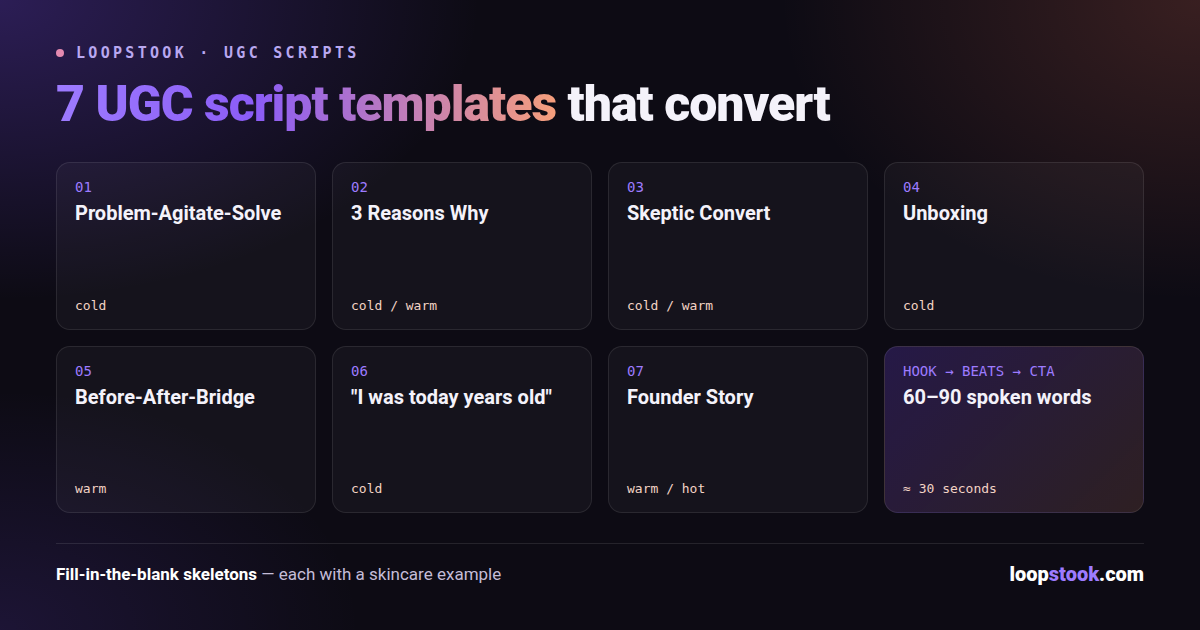
A UGC script template gives you the proven skeleton of a converting creator ad — hook line, body beats, CTA — so you only fill in the product specifics. Below are seven copy-paste templates, from Problem-Agitate-Solve to Founder Story, each with structure notes and a filled-in skincare example you can adapt in minutes.
They work for human creators and AI avatars alike — adaptation notes below cover the differences.
What Makes a UGC Script Template Convert?
Five things: a hook that lands inside two seconds, one single idea per script, spoken-not-written language, concrete proof instead of adjectives, and exactly one CTA. Every template below enforces that structure — which is precisely why templates beat blank pages for conversion work.
A 30-second UGC script is roughly 60–90 spoken words, so every line earns its place. Rather than filling blanks by hand, the free UGC script generator produces drafts for your product in this same hook-beats-CTA structure.
The 7 UGC Script Templates
1. Problem-Agitate-Solve (PAS)
The workhorse. Hook names the problem bluntly; body makes it sting, then introduces the product with one mechanism; CTA is low-friction.
HOOK: [Blunt statement of the problem, in the buyer's own words]
AGITATE: [Why it's worse than they think / why common fixes fail]
SOLVE: I started using [product] — it works because [one mechanism].
PROOF: [One specific, honest detail you noticed]
CTA: [Single next step]
Skincare example:
HOOK: My skin was flaky AND breaking out. At the same time.
AGITATE: Every "hydrating" cream I tried just sat on top and clogged me.
SOLVE: This barrier serum actually sank in — it's the ceramides.
PROOF: By week two the flaking around my nose was just... gone.
CTA: It's linked below if your skin is doing both at once too.
2. 3 Reasons Why
A listicle in video form. The hook promises a countable payoff; each beat is one reason with one detail; the CTA ties to reason three.
HOOK: Three reasons I keep rebuying [product] — number [2/3] surprised me.
REASON 1: [Most obvious benefit + one concrete detail]
REASON 2: [Unexpected benefit — the "surprise"]
REASON 3: [Practical/economic reason: lasts long, replaces two products]
CTA: [Next step tied to reason 3]
Skincare example:
HOOK: Three reasons I keep rebuying this serum — number two surprised me.
REASON 1: One, it layers under sunscreen with zero pilling.
REASON 2: Two, it calmed the redness I've had since my twenties.
REASON 3: Three, one bottle outlasted my moisturizer and toner combined.
CTA: Grab it below — one bottle is honestly all you need to test it.
3. Skeptic Convert
The most trusted frame in UGC because it starts on the viewer's side of the argument. Hook is the doubt; body is the reluctant test; proof must be specific.
HOOK: I fully expected [product] to be a scam.
DOUBT: [Why you didn't believe it — past failures, hype fatigue]
TEST: I tried it for [timeframe] just to prove it wrong.
TURN: [The specific moment you changed your mind]
CTA: [Soft CTA — "see for yourself" energy]
Skincare example:
HOOK: I fully expected this viral serum to be a scam.
DOUBT: Every "miracle" serum I've bought did absolutely nothing.
TEST: So I used it every night for a month, purely to dunk on it.
TURN: Then my mom asked what I'd changed. Unprompted. My MOM.
CTA: I'm not saying buy it. I'm saying check the before-and-afters.
4. Unboxing / First Impression
Real-time discovery energy. The hook is the package arriving; the beats are honest live reactions; the CTA promises a follow-up, which also sets up a retargeting ad.
HOOK: My [product] just arrived — okay, let's see if the hype is real.
BEAT 1: [Packaging/first-touch reaction — texture, size, smell]
BEAT 2: [First use, narrated as it happens]
BEAT 3: [Instant verdict + what you'll watch for over time]
CTA: Follow for the [timeframe] update — link's below if you can't wait.
Skincare example:
HOOK: The serum everyone's posting just arrived. Let's see.
BEAT 1: Okay, the dropper is weighty — this doesn't feel like $20 packaging.
BEAT 2: Putting it on now... it's gel, not sticky, sinks in fast.
BEAT 3: Immediate glow, but I care about the redness — watch this space.
CTA: Follow for the 30-day update. Link below if you can't wait.
5. Before-After-Bridge
Show the destination, then sell the vehicle. Hook is the after; body rewinds to the before; the bridge is the product plus timeframe. Keep claims honest and specific.
HOOK: [Show the "after" — the result, on camera] This took [timeframe].
BEFORE: Rewind — [what it looked/felt like before, specifics].
BRIDGE: The only thing I changed was [product], [usage pattern].
AFTER: Now [current state + how it feels day to day].
CTA: [Next step + set expectations honestly]
Skincare example:
HOOK: This is my skin with zero filter. This took eight weeks.
BEFORE: Rewind two months: texture, dullness, foundation looking patchy.
BRIDGE: The only change was this serum, every night after cleansing.
AFTER: Now I skip foundation most days. Actual sentence I just said.
CTA: Linked below — give it the full eight weeks like I did.
6. "I Was Today Years Old"
Rides a native TikTok phrase. The hook is a genuinely useful discovery; the body explains why everyone gets it wrong; the product enters as the fix.
HOOK: I was today years old when I found out [surprising fact/mistake].
REVEAL: [Why the common way is wrong / what's actually happening]
FIX: [Product] does [the correct thing] — that's the whole trick.
PAYOFF: [What changed once you switched]
CTA: [Share-worthy CTA — "tell a friend who does this"]
Skincare example:
HOOK: I was today years old when I learned you apply serum to DAMP skin.
REVEAL: Dry-skin application wastes half of it — it can't bind water that isn't there.
FIX: Mist first, then this serum — the humectants finally have something to hold.
PAYOFF: Same bottle, double the plumpness. I was mad about the wasted months.
CTA: Send this to your friend who towels off like they're mad at their face.
7. Founder Story
Highest-trust, best for retargeting warm audiences. Hook is the origin problem; the body is the obsession; the CTA is personal.
HOOK: I made [product] because [the problem] nearly made me quit [context].
STRUGGLE: [What you tried, what failed, what it cost you]
OBSESSION: [The unreasonable lengths you went to building the fix]
STAKES: [Why you refuse to cut the corner competitors cut]
CTA: [Personal ask — "try what I built"]
Skincare example:
HOOK: I made this serum because my rosacea nearly made me quit my own wedding photos.
STRUGGLE: Twelve dermatologist-recommended products. Two years. Nothing held.
OBSESSION: So I spent eighteen months with a chemist reformulating until my skin accepted it.
STAKES: We still batch it small, because the stability testing is the whole point.
CTA: If your skin rejects everything too — try the thing I had to build.
Which UGC Script Template Should You Use?
Match the template to the funnel stage and the belief you need to change. Cold audiences need pattern interrupts (PAS, "I was today years old" reveals); skeptical audiences need trust frames (Skeptic Convert, Founder Story); warm audiences need proof and urgency (Before-After-Bridge, Unboxing follow-ups).
| Template |
Best for |
Funnel stage |
| Problem-Agitate-Solve |
Products fixing a felt, nameable pain |
Cold |
| 3 Reasons Why |
Multi-benefit products, retention of attention |
Cold / warm |
| Skeptic Convert |
Hype-fatigued niches, viral products |
Cold / warm |
| Unboxing / First Impression |
New launches, premium packaging |
Cold |
| Before-After-Bridge |
Visible-results categories |
Warm |
| "I was today years old" |
Products with a usage insight or myth to bust |
Cold |
| Founder Story |
Trust-heavy categories, retargeting |
Warm / hot |
Pair whichever you pick with several tested opening lines from the free ad hook generator — the template controls the body, but the hook still decides whether anyone hears it. Our 50-hook testing playbook shows how to find the winner fast.
How Do You Adapt These Scripts for AI Avatars vs Human Creators?
For AI avatars: shorten every sentence, cut physical actions, and move demonstrations to b-roll. Avatars deliver clean lines well but can't credibly apply serum to their own face — so script the avatar for the talking beats and cut away to generated product footage for anything hands-on.
Three avatar-specific tweaks: write brand names phonetically, keep sentences under about twelve words, and let captions carry any complex claim. Human creators get the opposite: hand them beats, not word-for-word lines, and let them riff — the riff is the value. Category-specific walkthroughs, including full shot lists, live in AI UGC for skincare, and the broader workflow is in our AI UGC ads guide.
One compliance note: where a synthetic performer delivers the script, disclose it. New York's synthetic performer disclosure law took effect June 9, 2026 — ads using AI-generated actors must say so, with fines for violations. Product-first versions of these scripts (voice-over plus b-roll, no synthetic human) avoid the performer question. Not legal advice; confirm specifics with an attorney.
Turn a Template Into a Script in Seconds
Pick a template, then let the free UGC script generator fill the blanks for your product — and produce the whole ad, from script to video to captions, inside one creative suite. Start free at loopstook.com — no card required.