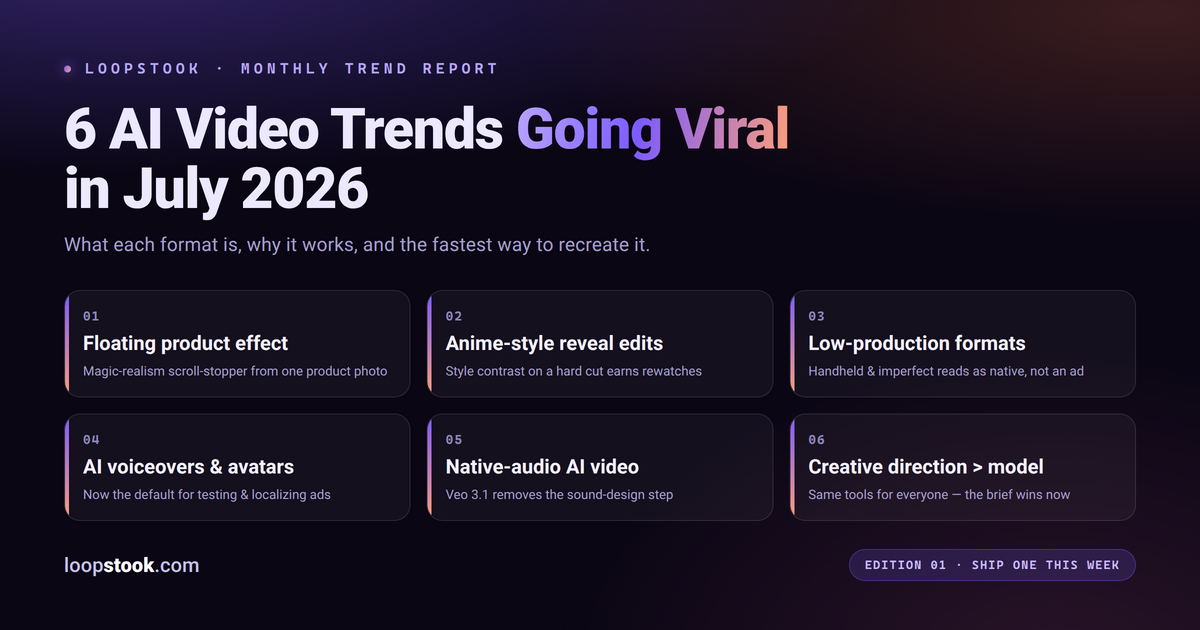
The AI video trends defining 2026 as of July are the floating product effect in ecommerce ads, anime-style reveal edits, low-production formats outperforming polished spots, mainstream AI voiceovers and avatars, native-audio generation via Veo 3.1, and creative direction replacing model quality as the real differentiator. Here's what each one is, why it works, and how to recreate it.
This is the first entry in our monthly trend report. Each edition breaks down what's actually pulling views and conversions right now — not model announcements, but formats you can ship this week.
What Are the Biggest AI Video Trends in July 2026?
Six trends dominate this month, and they share a theme: the models are good enough that how you use them matters more than which one you use. The table below is the summary; the sections that follow show how to recreate each format.
| Trend |
Why it works |
Fastest way to recreate it |
| Floating product effect |
Magic-realism pattern interrupt |
Image-to-video from one product photo |
| Anime-style reveal edits |
Style contrast drives rewatches |
Stylized generation + hard-cut reveal |
| Low-production formats |
Reads as native, not as an ad |
Handheld, imperfect prompts |
| AI voiceovers & avatars |
Cuts talent cost and turnaround |
Voice-over + avatar presenter |
| Native-audio AI video |
Removes the sound-design step |
Veo 3.1 with audio in the prompt |
| Creative direction > model quality |
Everyone has the same tools |
Better briefs, hooks, and shot lists |
Why Is the Floating Product Effect Everywhere?
The floating product effect — a perfume bottle or sneaker levitating and slowly rotating in a styled scene — is July's dominant ecommerce ad format because it's a magic-realism pattern interrupt that still keeps the product as the hero. It stops the scroll without hiding what's for sale.
It works because it violates one physical expectation (gravity) while keeping everything else photoreal: lighting, reflections, materials. The brain flags it as impossible, attention spikes, and the product gets two full seconds of undivided focus — an eternity in feed terms.
To recreate it: take one clean product photo, feed it to an image-to-video model, and prompt slow levitation, gentle rotation, and a light source that shifts as it turns. Full workflows live in our AI ads for ecommerce guide.
What's Behind the Anime-Style Reveal Edit?
Anime reveal edits transform a real person, product, or storefront into an anime scene — or snap from anime back to live action — and they're spreading because the style contrast earns rewatches. Viewers loop the video to catch the exact frame where reality flips.
Anime aesthetics are fully mainstream in Western feeds, and AI video finally handles stylized motion without melting faces. Brands use it as a before/after device — mundane real shot, hard cut, heightened anime version of the same moment.
To recreate it: generate the anime half with a stylized prompt ("hand-drawn anime film style, dramatic lighting, wind-blown detail"), then hard-cut between the real footage and the generated clip on a beat. The cut is the hook — put it in the first two seconds.
Why Is Low-Production Content Beating Polished Ads?
Deliberately imperfect, low-production AI video is outperforming cinematic spots in paid social because it reads as native content rather than advertising. Handheld framing, casual pacing, and phone-quality texture signal "person," not "brand" — and feeds reward whatever doesn't feel like an interruption.
Counterintuitive if you're paying for cinematic-grade models, but the logic holds: polish is now cheap, so it no longer signals value. Authenticity cues do. The best-performing AI ads this month look like a customer filmed them.
To recreate it: prompt the imperfection explicitly — "handheld smartphone footage, natural window light, slightly shaky" — and resist the urge to color-grade it back to gloss. Physical realism helps here, which is where Sora 2 is strong: believable hands, weight, and object interaction sell the "someone actually filmed this" read.
Are AI Voiceovers and Avatars Mainstream in Ads Now?
Yes — July 2026 is the month AI presenters stopped being a novelty in ad creative. Brands now run AI voiceovers and avatar spokespeople as the default for testing, localizing, and scaling ad variants, reserving human talent for hero campaigns rather than every cutdown.
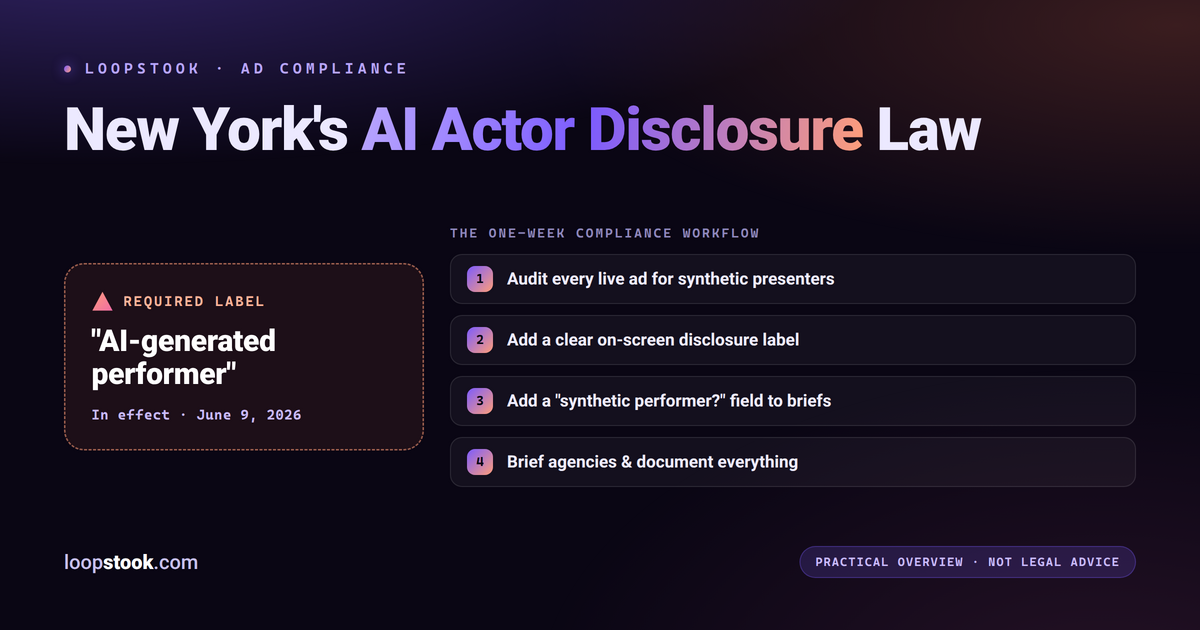
The economics drove it: an avatar variant costs a prompt, not a reshoot. But regulation arrived with the scale — New York's synthetic performer disclosure law took effect June 9, 2026, meaning AI actors in ads must be disclosed, with fines for violations. If you're running avatar creative into US markets, build the disclosure into your template now rather than retrofitting it later.
To recreate it: script the spot, generate the voice-over with a tool like ElevenLabs v3, and pair it with an avatar or product-focused B-roll. Keep scripts conversational — avatar creative fails when the copy sounds like a press release.
What Does Native-Audio AI Video Actually Change?
Native-audio generation means the model produces synchronized sound — ambience, effects, even speech — in the same pass as the visuals, and Veo 3.1 has made this practical. It removes the sound-design step entirely for short-form ads.
Before this, every AI clip shipped silent and someone had to source foley, music, and mix — the step where most small teams' videos stalled or shipped with a generic trending track. Now "glass clinks, café ambience, soft jazz" goes in the prompt and comes out synchronized.
The catch is cost discipline: Veo 3.1 runs about $3.31 per 5-second 720p clip on LoopStook (Pro plan and above), so the smart workflow is drafting motion with a cheaper model, then regenerating the winning concept in Veo 3.1 when audio matters.
Why Is Creative Direction the New Differentiator?
Because everyone has access to the same models now, output quality has stopped separating winners from losers — creative direction has. Two teams prompting Veo 3.1 get comparable fidelity; the one with a sharper hook, a real shot list, and a point of view gets the views.
The skills that matter now are old ones: concepting, pacing, copywriting. Every trend above is evidence — floating products, anime reveals, and lo-fi formats are directorial choices, not model features.
Practical upgrade: treat every generation like a brief. Define the hook frame, the emotional beat, and the caption before you prompt. A free AI caption generator closes the loop faster than writing captions last, when your judgment is spent.
Steal a Trend This Week
Pick one format above — the floating product effect is the fastest win for ecommerce — and ship a test this week with the AI ads for ecommerce workflow. LoopStook puts all 13 video models, Nano Banana Pro, and the free marketing tools under one subscription. Start free at loopstook.com — trial credits, no card required.